
Deep Dives
Phase 2 of the CoSi scenario framework, termed Deep Dives, builds on the results of the CROSS Scenarios of Phase 1 and addresses specific sub-topics (i.e. local developments, sectoral questions, follow-up questions on the national layer). Deep Dives are envisioned to open up the assessment space of the overarching scenario-based framework.
The main objectives are:
- Extend the coverage of the scenario assessment beyond the typical techno-economic energy system focus
- Allow integration of modeling and non-model-based assessments
- Provide a more (topical) focused structure so stakeholders and researchers can more easily identify if it links to their interests
- Different layers and topics allow different groups to participate where their expertise is best utilized and the heterogeneity of the community becomes an asset not a barrier
- Enables more tailored communication of sub topics
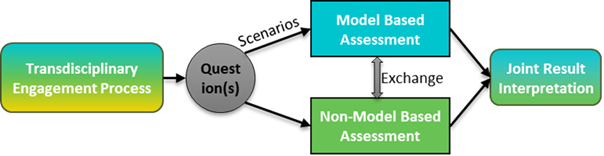
The main element for each assessment within a Deep Dive (as well as for the CROSS runs) is the definition of the underlying question(s) that set the objective(s) for participating research groups. Ideally, the definition of the question(s) emerges from a joint and transdisciplinary process to ensure that the purpose of the assessments is clear from the start, but it can also stem from other sources (e.g. a already running project that could benefit from utilizing the CROSS result data to perform its investigation, master theses building upon CROSS/CoSi results, related research ideas etc.).
The resulting research question can then be ‘answered’ by different means:
- For numerical model assessments, a translation of the question(s) into a scenario structure and accompanying dataset is needed so that the participating models can be harmonized with regard to the main question aspects (i.e. this is similar to the CROSS scenario approach in phase 1)
- For non-model based assessments, no standardized ‘scenario process’ will be implemented to enable a large range of research groups to participate; if scenario structures are part of the assessment method a close coordination with the model based stream should be ensured.
A Deep Dive can include different approaches and teams trying to answer the same question with different means, a set of teams using similar methods (e.g. like the model comparison appoach of CROSS for model based assessments, or multiple empirical teams, or other methods and approaches) or be a single team tackling a question. The different Deep Dive insights are then transferred into the larger CoSi scenario communication proving the larger picture, while the specific Deep Dive insights can be communicated individually by the involved research teams as they see fit.
Deep Dives 2025+
The Deep Dives building upon the CROSS 2025 runs are the first Deep Dives conducted within the CoSi scenario framework, so please expect some missing guidance, templates and structures as it is work-in-progress and learning-by-doing still.
A first kick-off gathering ideas for potential Deep Dive topics has been conducted in spring 2025 at the first CoSi Scenario workshop and the 2025 SSH Energy Workshop. The resulting ideas can be found in the following Miro-Board
During the CoSi Assembly 2025 a workshop on ideas for the topical area of ‘Flexibility’ has been conducted with the aim to develop a joint Deep Dive of modeling and non-modeling teams based on the CROSS 25 results. An overview about the discussion and potential topical directions along this Deep Dive can be found here.
At the CROSS dissemination workshop in March 2026 a first roadmap for the Flexibility Deep Dive will be developed.
Q&A
How can I participate in a Deep Dive?
If you are interested to develop a new Deep Dive please contact please contact the SWEET management office either via info@sweet-cosi.ch or hannes.weigt@unibas.ch. If you want to join an existing Deep Dive, we will provide an overview of currently running Deep Dives at this webpage with contact details once they are started (still work-in-progress for now).
Who can participate in a Deep Dive?
Any research team interested to conduct investigations either utilizing the provided data of CROSS Hub or conducting related energy transition research is welcome to join. For the Deep Dives 2025 beside the CROSS guiding questions we are open to a wide range of ideas; a joint focus lies on topics related to households and their role in a more flexible electricity system. For later Deep Dives we may limit the topical focus.
Does CoSi provide resources for participation in a Deep Dive?
Unfortunately, CoSi does not have funding for financing specific model runs or deep dives. We provide the infrastructure for data exchange (via CROSS Hub), overarching scenario questions, general exchange between research teams via our workshops and via the WeDoEnergy platform, and manage and support an overarching communication and outreach strategy.
Are there specific guidelines for participating and providing insights for Deep Dives?
For model and data-based research, the Deep Dives should be linked to the CROSS Hub structure to ensure that the resulting data is available for other research teams and the joint CoSi scenario communication.
For non-model/data-based research we aim to develop templates for report/paper upload. But those will likely only follow in the second scenario assessment loop. For now, a simple documentation of the findings (i.e. paper, report, policy brief) is sufficient.
What will be done with my research results?
With the overarching scenario framework, CoSi aims to obtain a repository of result data from different investigations as well as the derived insights via simple text-based document (i.e. your normal papers/reports) for the guiding question. Based on those diverse results CoSi will provide a summarizing overview and interpretation (i.e. the bigger picture) that will be disseminated via the CoSi channels. The approach is planned to be similar to review/white papers; i.e. building purely on existing public available results and insights (the data provided via CROSS Hub and the Deep Dive reports/papers) and deriving conclusions and recommendations out of those for Swiss energy stakeholders. CoSi will not take copyright for any results provided, simply cite them; i.e. both the data-based results and text-based documentation provided to CoSi will remain yours and can (and should) be published in whatever way you prefer.