

Leader:
Goran Seferovic (ZHAW)
Isabelle Stadelmann (UNIBE).
What we do:
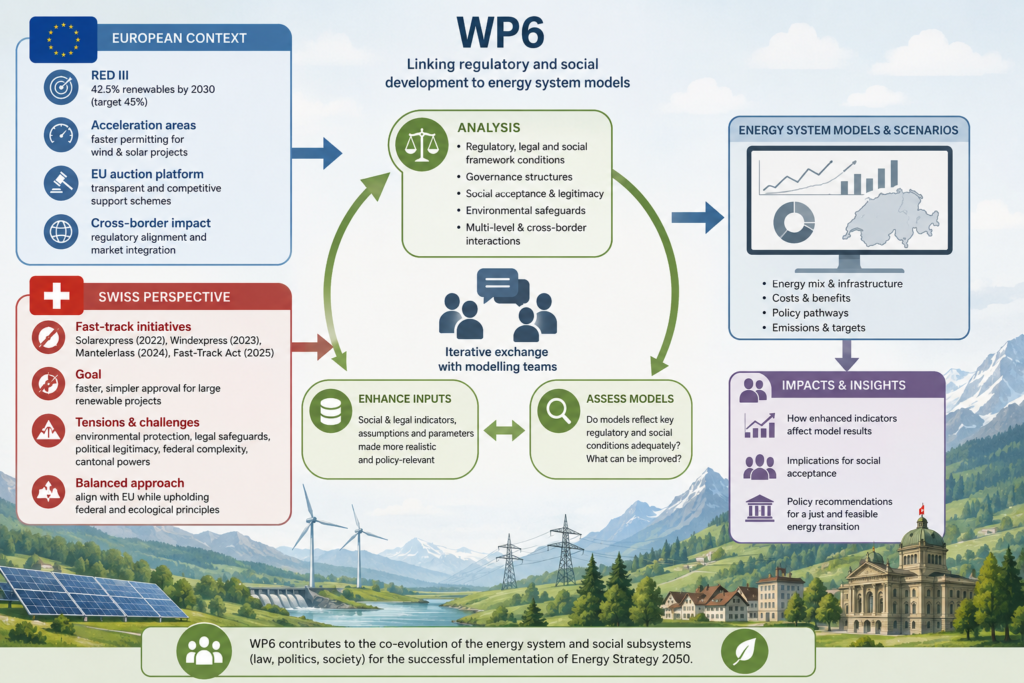
WP6 examines selected models and scenarios from a political science and legal perspective to see whether and how they take into account key regulatory, institutional and social development conditions shaping the energy transition. Particular attention is paid to evolving European and Swiss regulatory frameworks, including renewable energy acceleration policies, permitting procedures, and governance challenges. The work conducted in the workpackage aims at an iterative process with modelling teams to make model input more “realistic” and to investigate how socially and legally enhanced indicators affect modelling results. In this way, WP6 contributes to a co-evolution of the energy system and other social subsystems such as law and politics in particular.
Objectives:
- Analyzing key regulatory and social development conditions and co-evolutionary processes relevant for the energy system and related measures underpinning the Energy Strategy 2050, including the influence of European regulatory developments and Swiss policy responses, and making them suitable for models and scenarios.
- Based on this, selected models and scenarios are then examined to determine whether their parameters and criteria take sufficient account of key regulatory, institutional and social framework conditions. For example, it shall be evaluated in how far assumptions and indicators are realistic in view of regulatory and governance challenges such as permitting procedures, political support for policies or projects, environmental safeguards, or interactions between European and Swiss regulatory frameworks. As a main output, assumptions and indicators shall be identified that can be improved relying on social science data.
- Finally, the results of selected models and scenarios will be examined to see whether and how the inclusion of enhanced indicators affect modelling results and their social acceptance. Moreover, it will be analysed how alternative regulatory pathways, governance arrangements, and implementation challenges influence scenario outcomes and the feasibility of the energy transition.